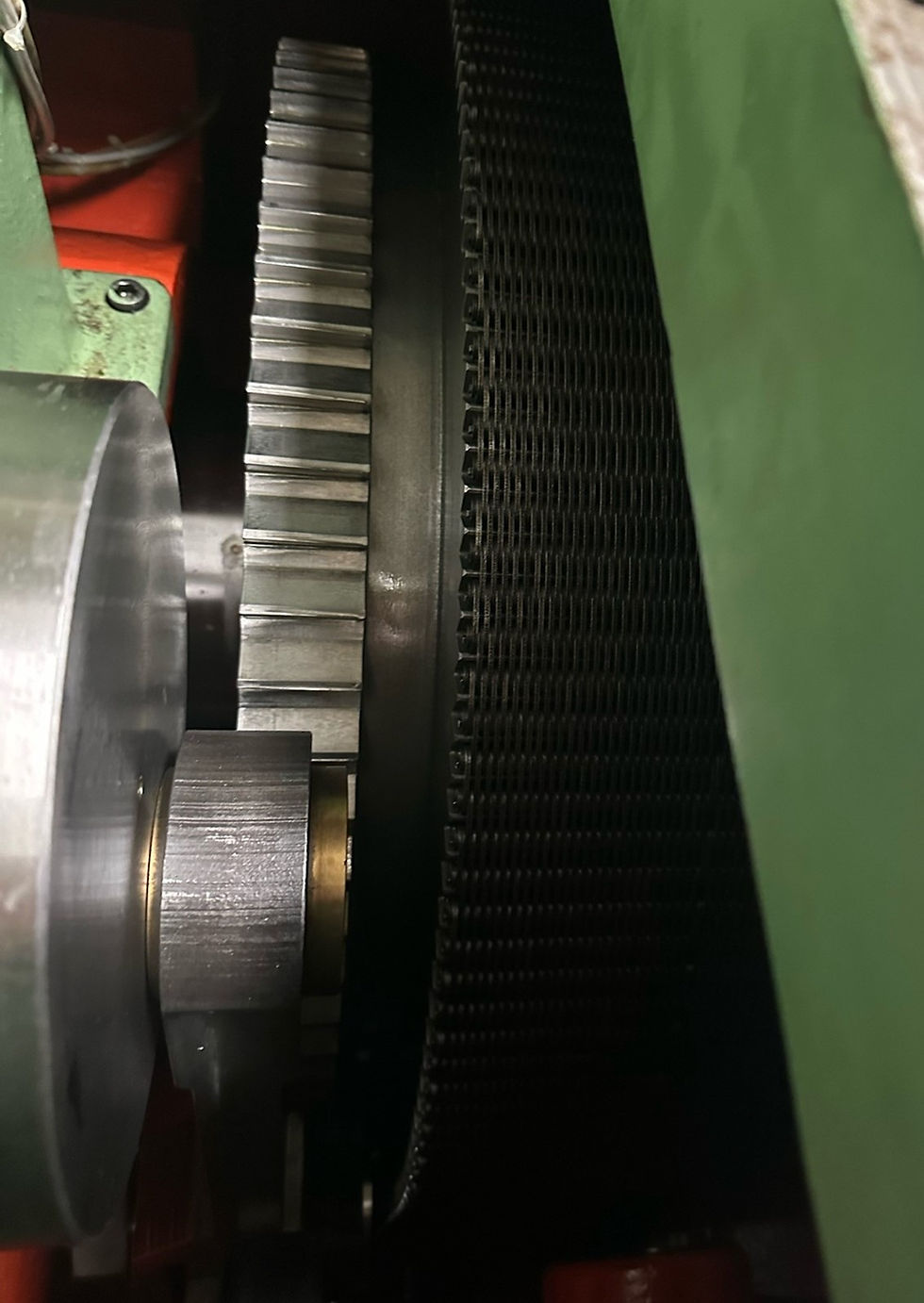
Modal Analysis on Roll Grinder
Updated: Jan 9
Background

A roll grinder was experiencing vibration related quality issues, in the form of chatter marks with a pitch of around 14 mm. Results of previous investigations indicated that resonant frequencies caused by structural weakness in the machine were amplifying vibrations during grinding. A modal analysis was conducted to identify the natural frequencies and deformation modes that were contributing to these issues.
Procedure
The analysis involved exciting the machine using an instrumented hammer while measuring vibration responses at various points with accelerometers. Frequency response functions (FRFs) were generated and integrated into a 3D model of the machine to identify natural frequencies, damping, and modal shapes.
Findings
Two significant resonant frequencies were identified:
Mode 1: A rocking motion of the machine bed and steadies about the traverse axis.
Mode 2: A torsional mode involving twisting of the bed and steadies.
Both modes confirmed that structural deformation on the roll side was amplifying vibration caused by the grinding process.
The analysis also demonstrated that the wheel head resonances didn’t coincide with these frequencies, ruling out the involvement of this side of the machine in the marking problem.
Recommendations
Operational adjustments: set the wheel speed to the optimal value determined through testing to avoid severe resonant excitation.
Component inspection: inspect headstock components for defects, particularly those linked to vibrations at multiples of roll speed.
Structural modifications: consider long-term solutions like changes to the bed-foundation connection or tuned mass dampers.
Conclusion
The modal analysis identified structural resonances as a primary cause of vibration issues. Immediate operational changes can mitigate quality issues but addressing structural and component issues is essential for sustained performance improvements.
This case study demonstrates why advanced vibration analysis applied on roll grinders is so effective when it comes to eliminating persistent chatter marks and enhancing machine performance.